

“For higher education institutions, the question is no longer whether change is needed, but how fast can institutions make it happen.” — Boston Consulting Group (BCG)
In 2025, higher education institutions are navigating significant financial headwinds: budget cuts, program elimination, enrollment declines, rising costs, and…the list goes on. It’s no longer business as usual. As BCG says, adapting to these new realities is crucial to survival.
Procurement teams are under more scrutiny than ever, but applying the right academic procurement strategies can make a real difference in meeting these challenges.
What Are the Biggest Procurement Challenges for Universities?
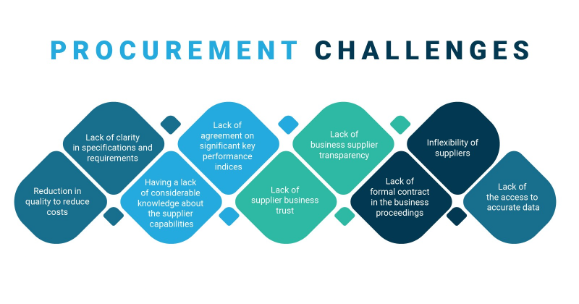
In 2025, here are five critical challenges that require your urgent attention:
- Budget cuts and financial pressures
- Decentralized purchasing and lack of spend visibility
- Compliance, risk, and governance gaps
- Managing supplier relationships and performance
- Talent gaps and resistance to change
Each of these challenges represents both a risk and an opportunity, depending on how you choose to respond.
1. Budget Cuts and Financial Pressures
Public funding is shrinking. Research dollars are disappearing. Tuition revenue has flatlined. Yet, your costs for technology, labor, utilities, and facilities keep going up. Procurement teams face a tough question these days: how do we do more with less?
The answer? A more strategic approach to procurement. Consider:
- Consolidating purchases across departments to leverage volume discounts
- Reduce maverick spending and bring more spend under contract
- Utilize cooperative purchasing agreements for greater cost savings
2. Decentralized Purchasing and Lack of Spend Visibility
Most universities have purchasing happening everywhere, with different systems across their campuses, AND departments operating independently. The result? Duplicate orders, inconsistent pricing, and zero negotiating leverage.
Without centralized data, you can’t identify waste or prove procurement’s value to leadership. Modern eProcurement platforms solve this by creating a single source of truth.
Consider:
- Implementing centralized procurement software to track all purchasing activity in real-time
- Using spend analytics to identify duplicate purchases and pricing inconsistencies
- Creating standardized approval workflows that speed up processing while maintaining control
- Generating dashboards that give leadership actionable insights into spending patterns
3. Compliance, Risk, and Governance Gaps
Higher education procurement is a compliance minefield. There’s a long list of grant requirements, state codes, internal policies, and inclusion and sustainability mandates. When purchasing is scattered across departments, keeping track becomes really tough, and the risk of penalties grows.
You can strengthen your governance framework by applying these academic procurement strategies:
- Standardizing approval workflows across all departments and campuses
- Automating contract renewal reminders to prevent lapses or missed opportunities to shop around for better deals
- Implementing consistent supplier vetting and onboarding processes
4. Managing Supplier Relationships and Performance
Universities work with hundreds or thousands of suppliers spanning every category imaginable. When doing more with less, supplier relationship management is often on the back burner, meaning things can fall through the cracks or opportunities to work together are missed.
You can take control of supplier management by:
- Deploying supplier performance dashboards to monitor delivery, quality, compliance
- Establishing KPIs tied to institutional priorities and holding suppliers accountable
- Using analytics to identify at-risk suppliers before they cause disruptions
- Tracking and reporting metrics covering university initiatives
When you have a framework in place for managing suppliers you can also free up time to invest in the relationship, which often produces better deals long-term and innovative solutions.
5. Talent Gaps and Change Management
There are several issues at play here. Across academic circles, we’re seeing a significant number of experienced procurement professionals retiring, taking all that institutional knowledge with them. You might not be able to rehire, either, due to hiring freezes. At the same time, younger team members are expecting a modern workplace powered by tech. And those in the middle are often slow to embrace digital transformation.
You’ve got to bridge this gap if you want to solve these university procurement challenges:
- Investing in professional development programs to make sure everyone has the digital skills they need
- Providing hands-on training and ongoing support when implementing new systems
- Making sure you have buy-in from the top and campus-wide
Building Procurement Resilience
Each of these challenges can become a catalyst for change. By shifting to a more strategic mindset, embracing a digital workflow, and continually looking for ways to improve your total economic benefit, you can position procurement staff as problem-solvers for financial concerns.
E&I Cooperative Services is a procurement partner, offering cooperative contracts from top-tier suppliers to help solve your university procurement challenges. E&I competitively solicits contracts for categories that academic institutions need, combining the demand from 6,000+ members. Because E&I is the only member-owned nonprofit sourcing cooperative solely focused on the education sector, you get ready-to-use cooperative agreements tailored to academic institutions and your complex compliance requirements.Whether you’re looking for cost-effective solutions for facilities and MRO, classroom supplies, eProcurement, technology, financial services, athletics, or more, you can find hundreds of competitive contracts through E&I. Contact E&I Cooperative Services today to talk to one of our education procurement experts.