

Search for the best LLM API and you will find a dozen confident, contradictory answers — because there isn’t a single one. The best API for real-time chat is not the best for deep reasoning; the best for high-volume classification is not the best for coding; and the best for a startup watching costs is not the best for an enterprise that needs compliance. “Best” is a function of your use case, and the smartest teams have stopped looking for one winner and started building setups that use the right model for each job.
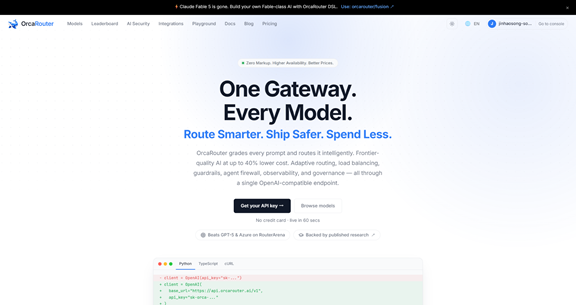
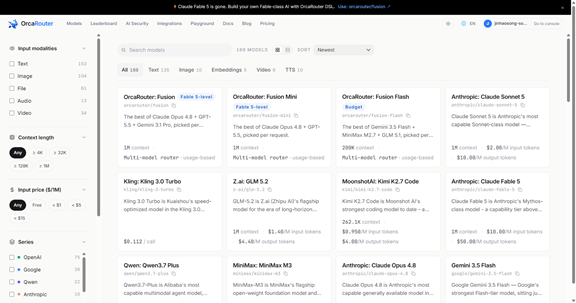
That is why the most practical answer to “what’s the best LLM API” is increasingly “all of them, through one endpoint.” A tool like OrcaRouter is an AI gateway that reaches 200+ models across providers, so you can route each task to whichever model is best for it without juggling accounts. This guide covers the criteria that actually matter, the main categories of LLM APIs in 2026, and how to choose for your situation.
Why there’s no single “best” LLM API
Models are specialized and they leapfrog each other constantly. A model that tops the charts today may be second by next quarter, and a model that is overkill (and overpriced) for tagging support tickets may be exactly right for legal analysis. Committing to one “best” API bakes in a bet that ages badly. The durable strategy is to stay flexible: judge APIs by criteria, not hype, and keep the freedom to switch.
The criteria that actually matter
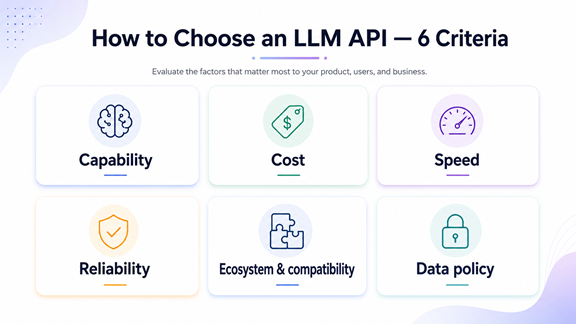
Judge any LLM API against six things:
- Capability — is it good at your specific task (reasoning, coding, extraction, multimodal)?
- Cost — what does it cost per completed task, not just per token, including retries?
- Speed — is its latency acceptable for your experience (real-time chat vs. batch)?
- Reliability — uptime, rate limits, and whether you have a failover option
- Ecosystem and compatibility — does it work with your SDK and tools, ideally via an OpenAI-compatible format?
- Data policy — is your data logged or used for training, and does that fit your compliance needs?
Weight these by your use case and the field narrows fast — usually to two or three models rather than one.
The main categories of LLM API in 2026
Rather than name a single winner, it helps to think in categories, because the “best” pick usually comes from more than one:
- Flagship reasoning models — the strongest at hard analysis, coding, and long-horizon tasks; best when quality outweighs cost
- Fast, low-cost models — excellent for high-volume, everyday work like classification, extraction, and short summaries
- Open-weight models — free to self-host or cheap via providers, ideal when you want control or data residency
- Multimodal models — for images, audio, or documents alongside text
Most production stacks end up drawing from several of these categories, which is exactly why a single account rarely stays “best” for long.
The best setup is usually several models
The strongest teams treat model choice like a routing problem, not a purchasing decision. They send each request to the model that wins on their criteria for that task: cheap models for the bulk of simple work, a flagship for the hard cases, an open-weight model where data must stay in-house. Getting there without a gateway means managing several providers by hand; with one, it is a configuration.
Access the best of all through one API
How to choose for your use case
Start from the task, not the brand. Write down the two or three criteria that matter most for it — say, cost and speed for high-volume chat, or capability and data policy for legal analysis — then test a small shortlist through one endpoint and compare cost per completed task. Let the winner be your default and keep a stronger model on hand for escalation. Re-check quarterly, because the leaderboard will have changed.
A worked example makes this concrete. Say you’re building a support assistant. Most tickets are routine, so speed and cost dominate — a fast, cheap model handles them well. But a small fraction involve billing disputes or policy questions where a wrong answer is costly, so those escalate to a stronger reasoning model. And because support data can be sensitive, you check each candidate’s data policy before committing. Three criteria, three different winners, one routing rule — and none of it requires betting the product on a single “best” API. That is the shape most real decisions take once you stop hunting for one winner and start matching models to tasks.
How to get started
- Create a free account and generate an API key
- Point your existing OpenAI SDK at the gateway’s base URL
- Shortlist models by your top criteria and test them through the same endpoint
- Set a default, route hard tasks to a stronger model, and revisit as new models launch
The bottom line
“Best LLM API” is the wrong question in 2026 — the winners change quarterly, and they change by task. The durable answer is a setup, not a model: criteria instead of hype, your own workload as the benchmark, and one endpoint that lets every task run on whichever model currently earns it. Teams that build that way never have to ask the question again.
Don’t bet on one “best” API. Start free with OrcaRouter and route every task to the right model through one OpenAI-compatible endpoint — 200+ models, automatic failover, zero markup.
FAQ
Are public LLM leaderboards reliable for choosing an API?
Treat them as a shortlisting tool, not a verdict. Leaderboard tasks rarely match your workload, top models cluster within noise of each other, and some models are tuned toward benchmark styles — your own task set will often rank them differently.
How often should I re-evaluate my model choice?
Quarterly is a sensible default, plus an ad-hoc check when a major model launches or your traffic mix shifts. Keep the evaluation script from your first comparison so re-running it costs an hour, not a project.
Do I need different models for different languages?
Often, yes — models differ meaningfully in non-English quality, and the gap is larger for lower-resource languages. If you serve multilingual users, test candidates on your actual language mix rather than assuming English results transfer.