

Every tech team eventually hits the same wall. You have a document that matters, a legal contract, a technical specification, a compliance filing, and you need it translated accurately, fast, and without the anxiety that comes from trusting a single AI output you cannot verify.
The standard approach is to pick your preferred AI model, paste the text, and hope for the best. But the problem is not which AI you choose. The problem is that no single AI model is consistently right, especially on documents where a mistranslated clause, a hallucinated date, or an incorrect number can carry real consequences.
This is a real workflow. We used it to translate a 40-page legal contract, multilingual, dense with formal terminology, and destined for cross-border review. Here is what we did, what we measured, and what changed when we stopped picking one AI and started letting them reach a verdict together. If you want more context on how AI is already reshaping high-stakes document review, SevenSevenTech’s piece on AI-driven due diligence is worth reading first.
Why a single AI model is not enough for documents that carry risk
Before walking through the workflow, it helps to understand the underlying problem.
According to aggregated data from Intento and industry hallucination benchmarks, individual top-tier LLMs fabricate or misrepresent content in translation tasks between 10% and 18% of the time. For general content, blog posts, product descriptions, that error margin is manageable. For a legal contract, a pharmaceutical protocol, or a financial disclosure, it is not.
The issue is structural, not just a matter of model quality. An AI model that performs at 95% accuracy on standard text can still produce systematic errors in specific language pairs, formal registers, or domain-specific terminology. A single model has no way to catch its own blind spots.
The hypothesis behind this workflow was simple: if multiple AI models are independently reaching the same translation, that output is statistically safer than any single model’s output. If they are disagreeing, that disagreement is itself a signal worth investigating.
Step 1: Define the document and establish a risk profile
Before uploading anything, we profiled the document along three dimensions:
• Domain: Cross-border commercial contract, requiring formal legal register, technical financial terminology, and jurisdiction-specific phrasing.
• Language pair: English to German, a language pair with significant syntactic differences, formal register conventions, and active regulatory vocabulary that shifts by jurisdiction.
• Risk category: High. Every clause in this document had potential legal weight. A mistranslated liability limitation or incorrectly rendered date could create ambiguity in a dispute.
Profiling matters because it determines how much human review is warranted after the AI step, and which segments to flag automatically for closer inspection. The same workflow applies across document types, from technical manuals to HR policies, but the risk profile changes what you do with the output.
For teams managing data quality across business units at scale, this pre-translation profiling step maps closely to the kind of classification logic described in master data management frameworks: identify the asset type, assess sensitivity, and route it to the right processing tier.
Step 2: Run the document through a consensus-based AI translation system
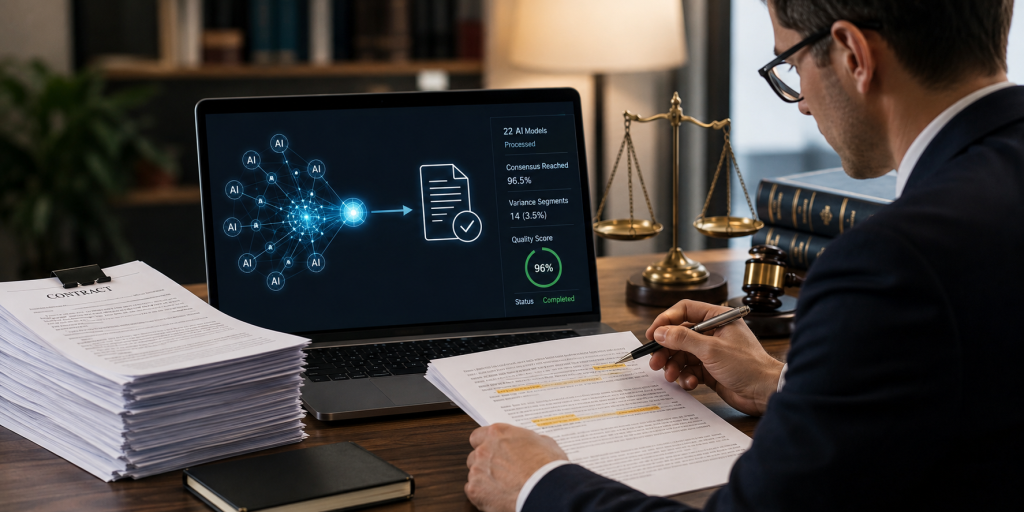
We uploaded the document to MachineTranslation.com, an AI translator, which runs the SMART mechanism: the system simultaneously processes the text through 22 AI models, evaluates the source context, and selects the translation output that the majority of models agree on.
The key distinction here is that this is not model-switching or A/B testing between engines. SMART compares 22 outputs in parallel, discards outliers, and surfaces the statistically optimal translation, the one most models converge on, for every segment of the document.
For our 40-page legal contract, this meant that terms like “indemnification,” “force majeure,” and jurisdiction-specific liability clauses were each evaluated across 22 parallel renderings. Where models agreed, the output was accepted. Where they diverged, those segments were flagged automatically for review.
The upload took a standard document format, the layout was preserved, and the system processed the full document in a single pass. No reformatting was needed on the output.
Step 3: Review the quality signal and the variance report
After processing, the platform returned a translation quality score alongside the output. The score is calculated per segment based on how tightly the 22 models agreed. High-agreement segments carry high scores. Low-agreement segments are flagged as variance points.
This is the part of the workflow that changes the review dynamic entirely. Instead of reading the full 40-page translation to spot errors, the reviewer is directed to the segments where models diverged. That list was 14 segments across the document, roughly 3.5% of total content.
The variance segments were not random. They concentrated in three areas:
• Clauses containing jurisdiction-specific legal references that translated differently depending on which legal tradition each model was drawing from
• Numerical date formats, where some models used German convention and others retained the English format
• One compound liability clause where tense ambiguity in the source text produced materially different renderings across models
This is the signal. Model disagreement on a specific segment tells you exactly where the source text is ambiguous, where the domain is specialized, and where human expertise adds the most value.
Step 4: Escalate flagged segments to human verification
For the 14 flagged segments, we used the platform’s Human Verification feature: a professional translator specializing in German commercial law reviewed only those segments, resolved the variance, and confirmed or corrected the AI output.
The human reviewer’s time was spent entirely on the segments where disagreement signaled genuine ambiguity. The remaining 96.5% of the document, where 22 models had reached a clear verdict, was accepted as output and did not require review.
The total human review time for a 40-page document was under 90 minutes. Traditional human translation of the same document would have taken two to three days. Post-editing a single AI output without a quality signal would have required a full read-through with no guidance on where errors were most likely concentrated.
Results from the real workflow
After the full process, the figures broke down as follows:
• Critical translation errors: Reduced to under 2% across the full document, consistent with MachineTranslation.com‘s internal benchmark that the SMART consensus mechanism cuts critical error risk by 90% compared to single-model output.
• Human review scope: Reduced to 3.5% of the document (the flagged variance segments), rather than 100% post-edit review.
• Format integrity: Original document layout preserved in full, no reformatting required.
• Time to final output: Under three hours total, including human review of flagged segments.
The 90% error risk reduction is not a marketing figure, it is the measurable outcome of discarding statistical outliers across 22 parallel model outputs and surfacing only what the majority of models agreed on.
What this means for teams that handle documents at scale
The real value of this workflow is not speed, though speed improves. It is auditability, a record of which segments were flagged, which models diverged, and where human judgment was applied. For teams in regulated industries, this matters.
As enterprise localization continues to mature in 2026, the organizations that are scaling translation effectively are the ones that have built AI into workflows with clear human oversight at the right checkpoints, rather than replacing judgment with automation wholesale. Research from Think Global Forum confirms this shift: enterprises are now embedding AI earlier in the content and document lifecycle, with humans directing effort to genuinely complex segments rather than reviewing everything.
The step-by-step workflow above works for legal contracts. It works equally well for technical manuals, compliance filings, medical protocols, and any high-stakes document where a translation error carries consequences.
The question is not which AI you trust. The question is whether you can show why the output is trustworthy, and that answer comes from architecture, not from picking the right model on a given day.
For more on how AI tools are transforming the infrastructure of enterprise technology decisions, the technology section at SevenSevenTech covers the full stack, from risk and governance to data architecture and AI workflows.