

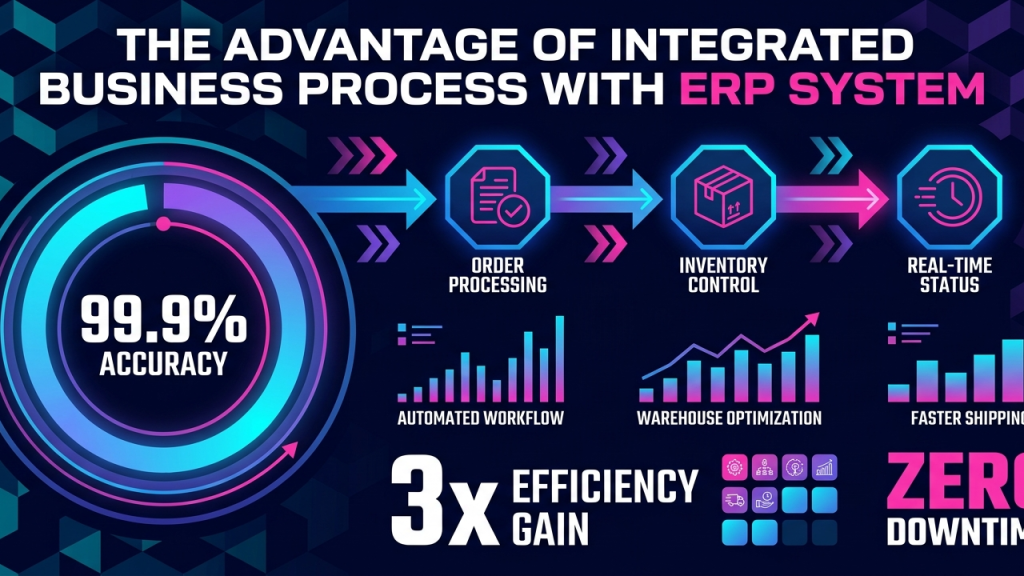
Contemporary businesses are extremely complex, with various departments that are forced to integrate effectively to attain business objectives. ERP systems are becoming more and more popular in organizations as a means to ensure that all processes and data in the organization are integrated. These platforms eradicate silos and make sure that all departments operate on one interconnected system. Top eam ERP software is critical in an ever-changing digital environment that assists businesses in smoothing operations, enhancing efficiency, and making appropriate decisions in real-time across all functions.
What Makes ERP Integration Important in Today’s Business World
Traditional business settings have isolated departments with various tools and systems that deal with finance, human resources, procurement, and sales. This generates discontinuous information and communication time lags and ineffective decision-making throughout the organization. ERP systems overcome these challenges by providing all major functions related to the business in one system.
Primarily, ERP integration is a guarantee that all departments are working off the same database and they can synchronize their data in real time, almost anywhere in the organization. As a team makes any update to information, this is immediately communicated to all modules, which enhances clarity, minimizes redundancy, and increases cooperation. To illustrate, a sales order triggers automatic changes in inventory, finance, and logistics, thus doing away with manual coordination and making ERP systems a fundamental component of an operating business today.
How ERP Systems Connect Different Business Departments
Finance and Accounting Integration
One of the most essential aspects of any ERP system is the finance department. ERP systems automate financial operations, including those of billing, invoicing, payroll, and expenses. Finance teams also have real-time financial visibility instead of trying to use manual spreadsheets.
All sales, procurement, and HR operations automatically feed to finances. This guarantees the proper reporting and adherence and minimizes human error. Real-time availability of data also makes budget planning and forecasting more accurate.
Human Resource Management Integration
ERP systems are of great advantage to the HR departments. Recruitment, onboarding, attendance tracking, payroll processing, performance evaluation, and many other functions are taken care of within the system.
Having the HR working with finance and operations gives an uninterrupted flow of employee data. An example is that attendance records automatically impact payroll calculations. This saves on the administrative burden and provides transparency in the management of the workforce.
Sales and Customer Relationship Management
The sales teams engage the CRM systems integrated in ERP to handle customer relations, to measure leads, and to track sales pipelines. All the customer communications are documented and distributed through the departments.
This integration will help in cooperation between the marketing, sales, and support teams. It also helps in forecasting since there is real-time sales analysis on customer behavior and trends. This has enabled the businesses to respond faster to the needs and customer demands of the market.
Supply Chain and Inventory Management
One of the most powerful aspects of ERP systems is supply chain integration. All these, such as inventory levels, procurement processes, warehouse operations, and logistics, are linked in the same system.
The ERP system can automatically create purchase orders when the stocks become less than a certain level. This provides a constant supply without the need to monitor. It also assists businesses in minimizing unnecessary stock and maximizing storage expenses.
The real-time tracking of shipments, deliveries, and supplier performance is beneficial to logistics teams.
The Power of Centralized Data in ERP Systems
One of the most important features of ERP integration is centralized data management. ERP platforms have a single database, which can be accessed by all departments, regardless of their location.
This centralized approach ensures:
- Tied together data throughout the organization
- Quick decisions with real-time insights
- Less work redone
- Better interdepartmental cooperation
Organizations are able to remove confusion brought about by conflicting sets of data due to just one source of truth.
Industry Applications of ERP Systems
ERP systems have been successfully employed in various industries, and they all have benefits that surpass others, including:
- Construction companies take care of projects, labor, and equipment monitoring
- Production planning and quality control are optimized in manufacturing firms
- Retail firms handle inventory, sales, and customers
- Fleet tracking and efficiency in making a delivery are enhanced
In places such as the Middle East, high-tech applications such as the enterprise asset tracking system UAE are usually combined with ERP applications to enhance visibility of assets and operational control of large enterprise industries.
Key Benefits of ERP Integration Across Departments
Increased Operational Efficiency
Automation in ERP helps to eliminate manual operations, enabling employees to work on value-added activities.
Improved Communication
Real-time collaboration of departments without manually waiting to have an update or report.
Real-Time Business Insights
The managers get access to dashboards, where they get immediate visibility of performance measures.
Cost Optimization
The companies saved a lot of money by streamlining inefficiencies and eradicating unnecessary systems.
Scalability and Flexibility
The business has grown with the contemporary ERP systems, which assist them in expansion without interruption of the systems.
The Future of ERP Systems
Artificial intelligence, machine learning, and predictive analytics are some of the advanced technologies that propel the future of ERP. Business enterprises are migrating towards smart ERP systems that not only run businesses, but also give insights and recommendations.
Cloud computing and mobile ERP solutions are also emerging as the norm, which enables businesses to operate anywhere in the globe. The future of enterprise operations will still be influenced by automation and real-time analytics.
Conclusion
ERP systems have gained prominence in businesses looking to attain efficiency at operational levels and integration at departmental functions. ERP fosters collaboration in real-time because it unites finance, HR, sales, supply chain, and project management on one platform and helps remove silos. Top eam ERP software will, however, be a key performance driver to web-based operations as businesses constantly transform and become digital.
Enterprise software innovation leader in the digital transformation space, ePROMIS provides a powerful cloud-based enterprise platform designed to unify and optimize business operations across industries. Their solutions include ERP, CRM, HCM, asset management, and project management systems built for scalability and efficiency. With AI-driven insights, automation, and real-time analytics, ePROMIS enables organizations to streamline workflows, improve productivity, enhance decision-making, and achieve complete digital transformation for smarter, faster business growth.